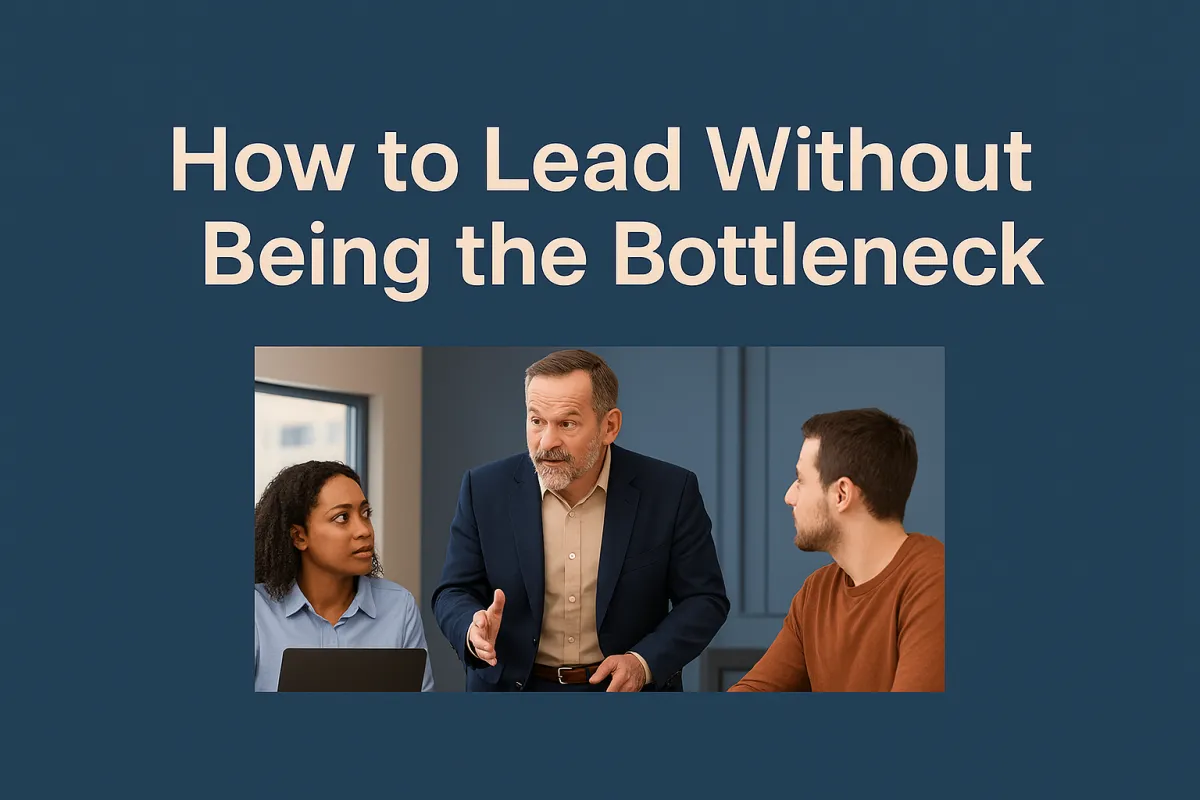
How to Lead Without Being the Bottleneck
Your calendar is full. Decisions queue up behind you. The team is capable, yet they still wait.
It's not that they lack skill. It's because they lack shared clarity.
For many CEOs, there is a familiar tension: the business could be moving faster than it is, yet everything still seems to route back through you. When that happens, it is easy to assume you need better people, more capacity, or a new structure. In most growing small businesses, though, the bottleneck is not a talent issue. It is a context issue.
Your team is not waiting for permission. They are waiting for context.
Why You Quietly Become the Bottleneck
No leader decides, “I’m going to slow everything down.” It happens gradually, and it often sounds reasonable:
“Just run this by me.” “Let me take a look before you send it.” “I’ll make the final call on that.”
At first, this feels responsible. You are protecting quality, managing risk, and staying close to what matters. Over time, though, those habits train the organization to pause instead of proceed. People learn that the safest move is to wait for your sign‑off, even when they are fully capable of acting.
Underneath that pattern, three things are usually unclear:
What “good” actually looks like in this situation
Which trade‑offs matter most (speed, margin, risk, reputation)
Who truly owns the decision, and when it genuinely needs you
When those pieces are vague, your team defaults to safety: check with the CEO, book another meeting, or delay rather than decide.
Tip 1: Shift From Control to Context in Real Conversations
One of the fastest ways to reduce bottlenecks is to change the way you handle decisions that already land on your desk.
The next time someone says, “Can you decide this?” resist the urge to simply give an answer. Instead, ask:
“Walk me through how you’re thinking about this.”
“What options did you consider?”
“Which one would you choose and why?”
Then add a line that demonstrates your decision thought process, such as:
“In situations like this, we prioritize margin over speed.”
“If it affects a client promise, I want to know. If it’s internal, you decide.”
“If the impact is under $X, make the call and let me know afterward.”
You still help shape the decision, but you are doing it by sharing how you think, not just what you think. Over time, your leaders start making calls the way you would, without needing to bring everything back to you.
Tip 2: Define Clear Guardrails for Your Top Leaders
High performers lead well when they have real ownership plus clear boundaries. If everything ultimately rolls back to you, you do not have a performance issue. You have a guardrails issue.
Choose your core areas. For example, sales, operations, finance, and people, and answer this for each direct report:
“What decisions do you fully own?”
“When do I want input, but not final say?”
“When is it important that I make the call?”
Then turn that into a simple statement they can use daily, such as:
“You can approve discounts within this range as long as we protect gross margin above X% and do not change existing contracts without a conversation.”
“You can change any internal process as long as it does not increase cycle time for clients or add headcount.”
Share these guardrails explicitly, document them on a single page, and revisit them quarterly. As people see where they truly have authority, they stop routing decisions through you by default.
Tip 3: Run a Weekly “Bottleneck Scan” With Your Team
Bottlenecks are rarely fixed by working harder. They are fixed by noticing the patterns that keep repeating.
Once a week, use a few minutes of your leadership meeting to ask three questions:
“Where did a decision get stuck last week?”
“Where did someone wait for approval they shouldn’t have needed?”
“What simple rule or principle would have unlocked that situation?”
Capture the answers as short, practical guidelines, not a complex framework. For example:
“If the impact is under one day of work, you decide and inform.”
“We never surprise each other in front of a client.”
“If it touches our top 10 accounts, we over‑communicate.”
Over time, you build a shared “how we decide” playbook that your leaders can use without you having to be in every conversation. The more that playbook is used, the less your calendar becomes the critical path for progress.
Bringing It Together
When you shift your focus from control to context, in how you answer questions, how you set guardrails, and how you run weekly conversations, you remove a surprising amount of friction from day‑to‑day leadership. Decisions stop piling up behind you. Your leaders start moving with more independence and confidence. And your role becomes less about unblocking the work and more about guiding the direction of the business.
This is the kind of shift that moves a business from founder‑dependent to system‑supported. Growth becomes more predictable, your calendar feels lighter, and your leadership becomes more sustainable for the long term.
Leadership Clarity Corner
Each week, I share one practical way to help CEOs and leadership teams gain clarity and alignment around a single growth system, so they can achieve predictable, repeatable growth and more personal freedom.
If you are noticing that decisions slow down, pile up, or always seem to land back on your desk, a good next step is to see where clarity is supporting you and where hidden dependencies are quietly holding you back. My free Leadership Clarity Assessment is a short, calm reflection designed to surface exactly that.